
Cultural insights on hiring in Japan vs the US and Germany
Three of the world's top economies, three very different hiring cultures. Why American and German subsidiaries find top talent in Japan so hard to win.
日本・米国・ドイツで、採用文化はここまで違う
世界有数の経済大国3カ国、しかし採用文化はまったく異なります。米独の日本法人がトップ人材の獲得に苦戦する理由とは。
日本、美国、德国,招聘文化差在哪
三个全球顶尖经济体,三种截然不同的招聘文化。为什么美德企业的日本子公司难以争取到顶尖人才。

Hiring in Japan is vastly different from hiring in the US and Germany. While all three countries are top global economies, the Japanese business culture can make it challenging for American and German subsidiaries to hire top talent.
From a communication style that avoids confrontation to a decision-making process that emphasizes consensus, understanding cultural nuances in Japan is key for multinationals from the US and Germany.
“If your business success relies on your ability to work successfully with people from around the world, you need to have an appreciation for cultural differences as well as respect for individual differences. Both are essential.”
— Erin Meyer
In this article, we discuss crucial aspects of the Japanese business culture and highlight key differences between hiring practices in Japan, the US, and Germany. Using these insights, you can design hiring processes that reflect Japanese cultural values and create work environments that promote collaboration and business growth.
The Japanese business culture is a reflection of the Japanese society. As such, hiring practices in Japan tend to favor candidates who demonstrate an ability to fit into the culture.
When hiring in Japan, keep these three cultural nuances in mind.
In Japan, it’s important to maintain group harmony in every aspect of work. One of the ways this is achieved is through building consensus.
The Japanese term for consensus-building is Nemawashi. This involves speaking with everyone who can influence the decision to iron out potential issues and ensure unity within the team.
During the hiring process, Japanese companies look for candidates with collaboration and interpersonal skills that can help build a harmonious work environment.
The Japanese society is built on strong hierarchical structures that promote respect for seniority and authority.
At the workplace, respect for authority provides a sense of order and stability as junior employees look up to higher-level colleagues for direction and answers.
When hiring in Japan, organizations usually prefer candidates who demonstrate respect for seniority and a willingness to defer decision-making to those in authority.
Japanese employees are known to be loyal to their employers. Although this is slowly changing, many employees value long-term commitments since these provide a sense of stability.
Data from the Japan Institute for Labor Policy and Training shows that 32.7% of employees have worked in the same organization for fifteen years or more.
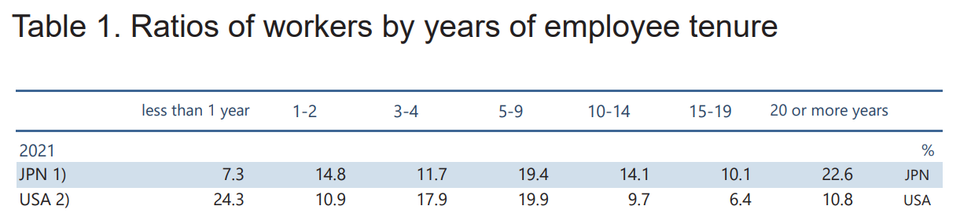
Source: Japan Institute for Labour Policy and Training
During the hiring process, companies prioritize candidates who show a willingness to stay with the same company for long periods and a desire to pursue long-term goals.
To fully appreciate the differences between hiring in Japan, the US, and Germany, we need to compare hiring practices in these countries.
Differences between hiring practices in Japan and the US mostly come down to communication and personal ambition. For US multinationals expanding to Japan, here are three things to think about.
- Individualism vs collectivism – US hiring practices prioritize candidates with noteworthy past achievements and an ability to take action individually. In contrast, Japanese hiring practices prioritize candidates who show an ability to collaborate and promote group harmony.
- Competitive job market – while candidates in the US actively look for job opportunities, their counterparts in Japan are usually comfortable working in the same company for many years.
- Direct vs indirect communication – recruiters and hiring managers in the US are used to direct answers to their questions. In Japan, it’s common for a response such as ‘I’ll think about it’ to be used instead of a more direct answer such as ‘No’.
According to KPMG’s German Business in Japan 2024 survey, 82% of German executives say their biggest challenge is hiring qualified personnel in Japan. Nonetheless, hiring practices in Germany are not very different from those in Japan.
Still, there are differences in matters such as:
- Qualifications vs employee loyalty – German recruiters hire candidates based on qualifications and cultural fit. Japanese recruiters on the other hand hire candidates who are not only qualified but also willing to stay with the company for many years.
- Career development – career growth in Germany is based on employee performance. In most Japanese companies, moving up the ranks is usually determined by length of service.
- Different communication styles – in Germany, communication between recruiters and candidates is often formal and direct. In Japan, communication is formal but indirect.
Here are tips to help you develop an effective hiring strategy in Japan.
1. Be Flexible With Job and Language Requirements
The demand for bilingual talent in Japan is very high. This is because only 3-4% of the Japanese talent pool is bilingual. This explains why many Japanese candidates struggle with English interviews.
According to the EF EPI 2023 report, Japan is ranked 87 out of 113 countries for English proficiency.
Companies that emphasize the candidate's English level end up ignoring their hard skills and strengths, leading to difficulty in securing top talent. If the position you’re filling doesn't require immediate English use, it's best to interview candidates in Japanese to determine their full potential.
2. Hire Candidates Quickly
In Japan's competitive talent market, securing top talent largely depends on two things: speed and a positive candidate experience. To stand out from the competition, you need to ensure a seamless interview process and provide prompt feedback to prospective hires.
Each interaction with candidates, from the initial application to the final interview stages, shapes their perception of your company. By prioritizing timeliness and personalization throughout the recruitment process, you can significantly improve the candidate experience and your employer brand.
With a positive candidate experience, you will build lasting relationships with potential hires and ultimately boost the success of your recruitment efforts.
3. Partner With a Recruiting Agency
Even after understanding cultural nuances in Japan, hiring the right talent can still be a challenge for US and German subsidiaries entering Japan. This is where a recruiting agency comes in.
Recruiting agencies in Japan know the ins and outs of the market, recruiting trends, and talent hotspots. A good recruiter will help you navigate the intricacies of the talent market and build a tailored go-to-market strategy for your company to find the perfect fit.
With an extensive network at their fingertips, local recruiters can quickly tap into a pool of qualified candidates who might not be accessible through other channels.
Japan is the most attractive market for global brands expanding to APAC. Although hiring in Japan is challenging, it doesn't have to be that way for you.
Hyre is a digitally-driven executive search and recruitment company that helps top companies and startups launch and scale their business across APAC. We specialize in building great teams for our clients with 110% Hyre energy.
Are you looking for a superstar talent? Let us find you one!
Hiring in Japan is vastly different from hiring in the US and Germany. While all three countries are top global economies, the Japanese business culture can make it challenging for American and German subsidiaries to hire top talent.
From a communication style that avoids confrontation to a decision-making process that emphasizes consensus, understanding cultural nuances in Japan is key for multinationals from the US and Germany.
“If your business success relies on your ability to work successfully with people from around the world, you need to have an appreciation for cultural differences as well as respect for individual differences. Both are essential.”
— Erin Meyer
In this article, we discuss crucial aspects of the Japanese business culture and highlight key differences between hiring practices in Japan, the US, and Germany. Using these insights, you can design hiring processes that reflect Japanese cultural values and create work environments that promote collaboration and business growth.
The Japanese business culture is a reflection of the Japanese society. As such, hiring practices in Japan tend to favor candidates who demonstrate an ability to fit into the culture.
When hiring in Japan, keep these three cultural nuances in mind.
In Japan, it’s important to maintain group harmony in every aspect of work. One of the ways this is achieved is through building consensus.
The Japanese term for consensus-building is Nemawashi. This involves speaking with everyone who can influence the decision to iron out potential issues and ensure unity within the team.
During the hiring process, Japanese companies look for candidates with collaboration and interpersonal skills that can help build a harmonious work environment.
The Japanese society is built on strong hierarchical structures that promote respect for seniority and authority.
At the workplace, respect for authority provides a sense of order and stability as junior employees look up to higher-level colleagues for direction and answers.
When hiring in Japan, organizations usually prefer candidates who demonstrate respect for seniority and a willingness to defer decision-making to those in authority.
Japanese employees are known to be loyal to their employers. Although this is slowly changing, many employees value long-term commitments since these provide a sense of stability.
Data from the Japan Institute for Labor Policy and Training shows that 32.7% of employees have worked in the same organization for fifteen years or more.
Source: Japan Institute for Labour Policy and Training
During the hiring process, companies prioritize candidates who show a willingness to stay with the same company for long periods and a desire to pursue long-term goals.
To fully appreciate the differences between hiring in Japan, the US, and Germany, we need to compare hiring practices in these countries.
Differences between hiring practices in Japan and the US mostly come down to communication and personal ambition. For US multinationals expanding to Japan, here are three things to think about.
- Individualism vs collectivism – US hiring practices prioritize candidates with noteworthy past achievements and an ability to take action individually. In contrast, Japanese hiring practices prioritize candidates who show an ability to collaborate and promote group harmony.
- Competitive job market – while candidates in the US actively look for job opportunities, their counterparts in Japan are usually comfortable working in the same company for many years.
- Direct vs indirect communication – recruiters and hiring managers in the US are used to direct answers to their questions. In Japan, it’s common for a response such as ‘I’ll think about it’ to be used instead of a more direct answer such as ‘No’.
According to KPMG’s German Business in Japan 2024 survey, 82% of German executives say their biggest challenge is hiring qualified personnel in Japan. Nonetheless, hiring practices in Germany are not very different from those in Japan.
Still, there are differences in matters such as:
- Qualifications vs employee loyalty – German recruiters hire candidates based on qualifications and cultural fit. Japanese recruiters on the other hand hire candidates who are not only qualified but also willing to stay with the company for many years.
- Career development – career growth in Germany is based on employee performance. In most Japanese companies, moving up the ranks is usually determined by length of service.
- Different communication styles – in Germany, communication between recruiters and candidates is often formal and direct. In Japan, communication is formal but indirect.
Here are tips to help you develop an effective hiring strategy in Japan.
1. Be Flexible With Job and Language Requirements
The demand for bilingual talent in Japan is very high. This is because only 3-4% of the Japanese talent pool is bilingual. This explains why many Japanese candidates struggle with English interviews.
According to the EF EPI 2023 report, Japan is ranked 87 out of 113 countries for English proficiency.
Companies that emphasize the candidate's English level end up ignoring their hard skills and strengths, leading to difficulty in securing top talent. If the position you’re filling doesn't require immediate English use, it's best to interview candidates in Japanese to determine their full potential.
2. Hire Candidates Quickly
In Japan's competitive talent market, securing top talent largely depends on two things: speed and a positive candidate experience. To stand out from the competition, you need to ensure a seamless interview process and provide prompt feedback to prospective hires.
Each interaction with candidates, from the initial application to the final interview stages, shapes their perception of your company. By prioritizing timeliness and personalization throughout the recruitment process, you can significantly improve the candidate experience and your employer brand.
With a positive candidate experience, you will build lasting relationships with potential hires and ultimately boost the success of your recruitment efforts.
3. Partner With a Recruiting Agency
Even after understanding cultural nuances in Japan, hiring the right talent can still be a challenge for US and German subsidiaries entering Japan. This is where a recruiting agency comes in.
Recruiting agencies in Japan know the ins and outs of the market, recruiting trends, and talent hotspots. A good recruiter will help you navigate the intricacies of the talent market and build a tailored go-to-market strategy for your company to find the perfect fit.
With an extensive network at their fingertips, local recruiters can quickly tap into a pool of qualified candidates who might not be accessible through other channels.
Japan is the most attractive market for global brands expanding to APAC. Although hiring in Japan is challenging, it doesn't have to be that way for you.
Hyre is a digitally-driven executive search and recruitment company that helps top companies and startups launch and scale their business across APAC. We specialize in building great teams for our clients with 110% Hyre energy.
Are you looking for a superstar talent? Let us find you one!